
Searching Calhoun County Criminal Dockets
For a Calhoun County Superior criminal docket, begin online at Georgia Courts E-Access. Think of E-Access as a directory of providers rather than one statewide case database. Its Calhoun Superior listing points to PeachCourt, which requires an account. Before login, the public screen offers only email and password fields. The name, case-number, and date filters appear after you sign in. Registration costs nothing, though some document images may carry fees.
Skip the internet when a docket search online turns up empty. The Superior Clerk answers at 229-849-2715. The office sits at the counter at 31 Court Street in Morgan, and takes mailed requests at P.O. Box 69, Morgan, GA 39866. Ask the clerk whether a public terminal exists instead of assuming one does. A fax number is published. The clerk gives no official word that certified-copy requests may go that route.
- Decide whether the matter is Superior, Magistrate, Juvenile, or municipal.
- Use E-Access to reach PeachCourt for a Superior case, then log in or register.
- Search with the case number, filing year, and caption details available to you.
- Compare the case result with the newest circuit criminal calendar or term itinerary.
- Ask the proper clerk for an older file, filed judgment, or certified disposition.
PeachCourt and Calhoun Felonies
Every felony charged in Calhoun County belongs to Superior Court. Georgia's e-file court matrix lists PeachCourt as mandatory for Calhoun Superior Court. That makes it the provider route for electronic filing and whatever documents it offers. Mandatory e-filing is not the same thing as a free public search. The login page opens no window onto every criminal docket in the county.
Check the court and the year before concluding a case does not exist. According to the Calhoun County clerk, computerized criminal indexing reaches back to January 1, 2000. Data goes to the state weekly. That claim covers indexing, not a promise that every image since 2000 is viewable. Older felony files stay permanent under Georgia's retention schedule. The clerk may need to pull paper or microfilm to serve them.
Inside a Calhoun County Criminal Docket
The legacy Calhoun County Superior Court Criminal Trial Calendar works well as a field map. Treat it as a map, not a live case search. Its columns show how a local criminal setting can join a case identifier with counts, charges, the cited Georgia law, offense date, counsel and prosecution slots, witnesses, setting date, and disposition. No document-image link appears in it. Nor does a balance, bond ledger, appeal link, or seal filter.
| Case identifier | The Superior case number or calendar position; no universal Calhoun format was published. |
|---|---|
| Count and charge | The alleged offense and, where shown, its Georgia Code citation. |
| Participants | Slots for counsel, assistant district attorney, and listed prosecution witnesses. |
| Setting | The event date and calendar stage, such as arraignment, pretrial, or trial. |
| Disposition | A result such as pled, dismissed, continued, no billed, or transferred, subject to the signed record. |
Any calendar heading deserves a check against the chronological docket and the final signed order. A heading can summarize a whole group of cases yet leave out the filed judgment itself.
Calhoun Charges Are Not Convictions
A charge printed on a Calhoun County criminal calendar is an allegation, nothing more. It proves no guilt. The older calendar sorts cases under labels like true billed, no billed, continued, pled, dismissed, and transferred back to municipal court. Such labels tell you the stage shown in that publication, but they never replace the final docket entry or signed disposition.
Check the final event. A certified judgment or disposition comes from the Clerk of Superior Court, not from an old calendar PDF.
For your own case, ask the clerk for the exact disposition document. Calhoun County posts no current local certification fee schedule, so confirm the cost and accepted payment before ordering.
How a Criminal Case Moves
A Calhoun County felony docket usually opens with an accusation, indictment, complaint, or special presentment. Arraignment comes next. The circuit's waiver form demands a Superior case number plus defendant and attorney signatures. It rejects faxed documents. From there, motions, notices, orders, pretrial settings, continuances, and trial settings stack into a dated event history.
Docket flow: Filing › Arraignment › Pretrial › Plea or Trial › Disposition › Sentencing
Bond, warrant, capias, and initial-appearance events can show up too. Calhoun publishes no local code list for them. The main outcome arrives through a plea, dismissal, no-bill, transfer, or verdict. Sentencing, probation, restitution, post-judgment motions, and appeal entries may follow. That is why the last line on an old calendar may not be the last event in the court file.
Calhoun's Criminal Term Cycle
The South Georgia Judicial Circuit itinerary sets Calhoun County criminal work inside term milestones. Its 2026 schedule names two Calhoun terms and lists grand jury, arraignment, motions-due, pretrial, and trial dates separately. Expect a planning calendar here, with no party names or individual case entries.
- Arraignment
- The stage when the filed charge is addressed and a plea may be entered.
- Motions due
- A filing deadline, not by itself a hearing date.
- Pretrial
- A setting used to address readiness, pending issues, and the path toward plea or trial.
- Trial calendar
- A list or term setting that still must be checked against case-specific notice and later orders.
When a general itinerary and the live court record disagree, the case-specific notice controls. Confirm the setting with the clerk before you travel.
Courts That Hold Criminal Dockets
The Superior Court of Georgia in Calhoun County tries felonies. The Superior Clerk maintains that criminal index and file. Magistrate Court takes warrants, preliminary hearings, and minor criminal matters. Arlington, Edison, Leary, and Morgan municipal courts each keep their own dockets. Those cover city traffic, ordinance, and limited misdemeanor matters. Juvenile matters fall under confidential access rules and sit outside any public adult criminal search.
| Court | Criminal work | First channel |
|---|---|---|
| Superior Court | Felonies and related Superior proceedings | E-Access to PeachCourt, then Superior Clerk |
| Magistrate Court | Warrants, early hearings, minor matters | 229-849-2115 or courthouse office |
| Municipal court | City ordinance, traffic, limited misdemeanor | The issuing city's clerk or ticket channel |
| Juvenile Court | Juvenile delinquency and related proceedings | Authorized access through the court |
A docket line that says transfer back to municipal court means the city court now handles the case again. The city's own docket channel is where to look. Treat the matter as a Superior felony no longer.
No Separate Calhoun Drug Docket
The circuit's accountability court page covers programs in Decatur, Grady, and Mitchell counties. Nothing there creates a separate Calhoun County drug, veterans, mental-health, or DWI docket. A Calhoun defendant can still get a referral. A supervision condition can land inside the underlying Superior file too. The official list just does not add a second local docket.
For filed criminal steps like the waiver of arraignment, the circuit's court-forms page is the better stop. It shows the forms a Calhoun case actually uses. View the source for the Calhoun criminal court forms image.
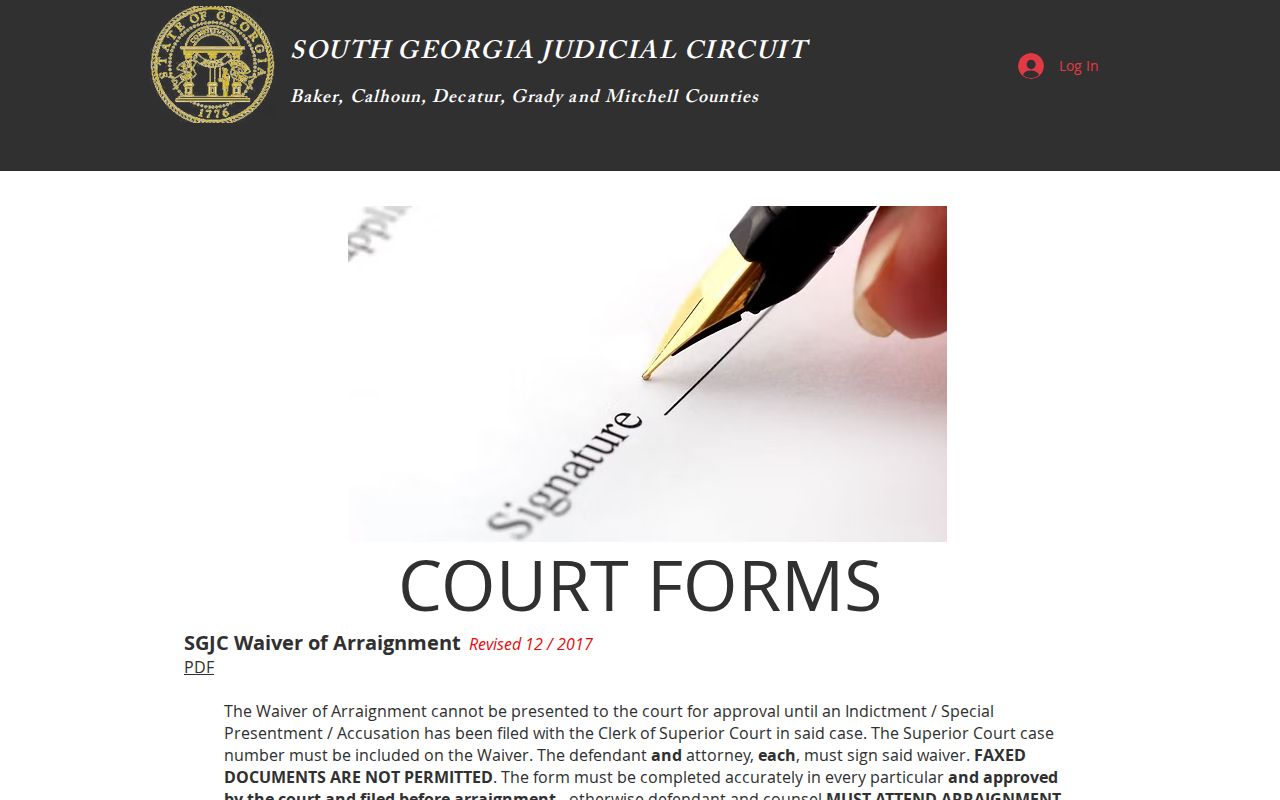
One caution from the forms. A valid arraignment waiver comes only after a charging instrument and a Superior case number are filed. The circuit's accountability page, meanwhile, shows where each program truly operates. See the source for the accountability court image.
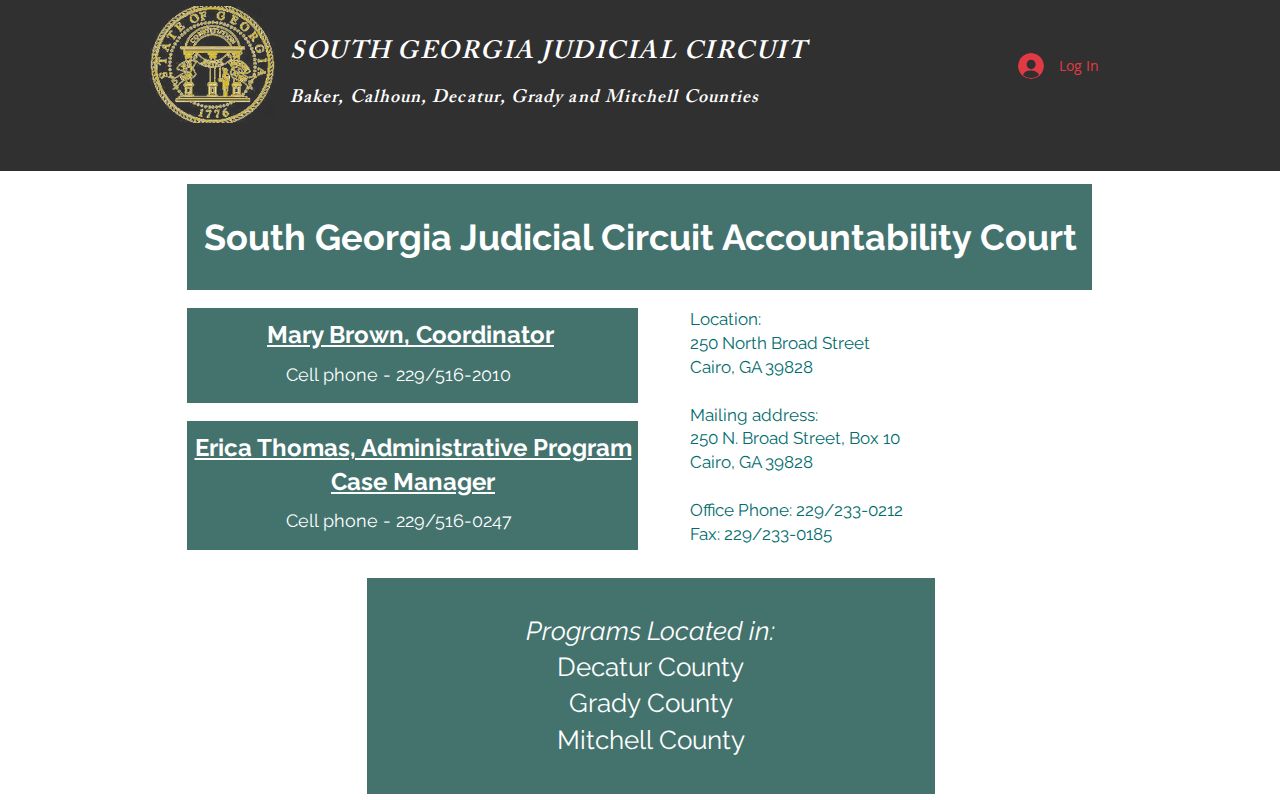
The county list does the real work here. It stops a reader from mistaking a circuit-wide program for a distinct Calhoun County criminal docket.
Sealed Dockets and Public Access
Court orders, juvenile confidentiality, and redaction rules all limit public criminal dockets. A sealed Calhoun County file can come back as no result. It may also show a bare shell entry or a restricted label. A name that turns up empty proves nothing about whether a case happened. Ask the clerk directly about the file. It could be sealed, juvenile, filed elsewhere, indexed differently, or simply outside the provider's coverage.
Access rules: Uniform Superior Court Rule 21 and Rule 21.6 govern access restrictions and sealing procedures. O.C.G.A. §§ 50-18-70 through 50-18-72 address public inspection, response, and exemptions. Juvenile files remain subject to separate confidentiality law.
When a public record exists but is not online, a written request is the fallback. The Georgia Attorney General's request guidance asks you to describe the record well enough for the custodian to find it, and to demand that any denial name the legal exemption. The agency never has to build a new analysis for you.
Older Calhoun Felony Files
Georgia's retention schedule makes Superior Court felony files permanent. That matters for any Calhoun County criminal docket that predates the clerk's computerized indexing start in 2000. It also matters where an indexed event has no public image. Ask the Superior Clerk how your requested year is stored. Paper or microfilm retrieval can take extra time. Give the clerk the court, the approximate year, the case number if known, and the exact document you want. A docket sheet, a filed judgment, and a certified disposition are three different products. The county posts no current fee table for them. So confirm the quote, payment method, return method, and certification need before you mail anything. Gaps in online coverage never prove an older permanent file is gone.